Berry Gordy built a catalog you can still sing in a stranger’s car by running Motown like the Ford plant he walked out of. The music business gave him a job title. Publishing would have diagnosed him with commercial intent.
In January of 1959, Gordy borrowed eight hundred dollars from his family. He was twenty-nine and had spent two years on the Ford line bolting chrome onto Lincolns for about eighty-five dollars a week. Then he quit to write songs and discovered that other people’s record labels liked paying songwriters in gratitude, which remains one of the creative world’s more stable currencies.
Gordy went to the Ber-Berry Co-op, his family’s savings club. His sister Esther kept the books and the books did not know he was family. The Gordys took a vote, then Esther made him sign a note for six percent over two years. He paid every penny back.
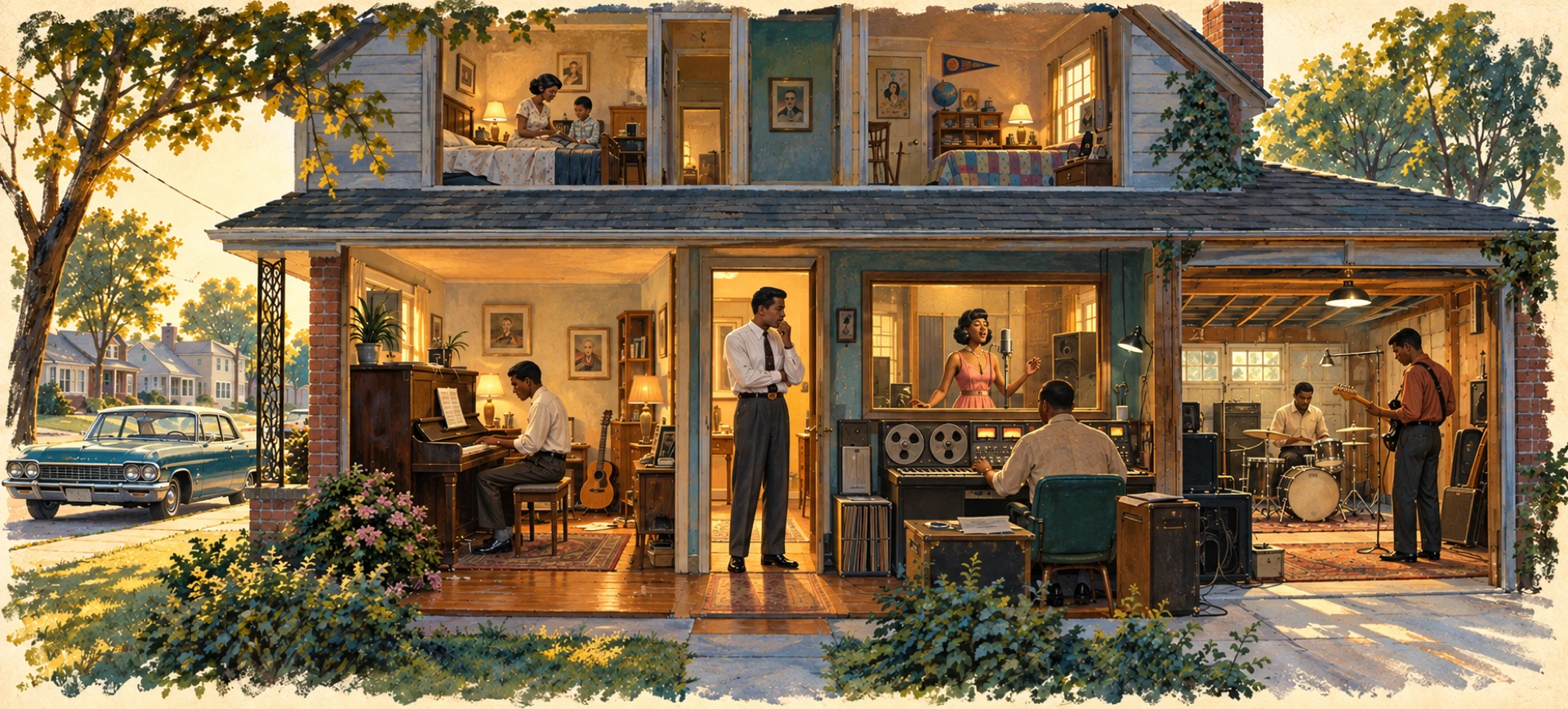
That August, he put three thousand dollars down on a two-family house at 2648 West Grand Boulevard. He moved his family upstairs, built a studio in the garage, and hung a sign over the door that read Hitsville U.S.A. The house is still there. Tours sell out weeks ahead, with people waiting to stand in a converted garage and look at a piano.
Gordy brought the assembly line with him. Thirty years later, he told Rolling Stone that he’d watched each man on the Ford line do one thing well before passing the car down, and wondered why the creative process couldn’t work the same way. At Hitsville, songs came through one door and moved room to room, with writers working in one while the band played in the garage. Down the hall, Maxine Powell ran what amounted to a finishing school for teenagers, some of them straight out of the Brewster projects, whom she expected to perform for kings and queens. Powell expected that booking to come. She taught them how to get out of a car without giving the crowd anything it had not paid for, and she told Marvin Gaye to open his eyes when he sang.
If you had one dollar and you were hungry, would you buy this record or a hot dog?
At the end of the line sat a door with Quality Control painted on it. Every Friday, salespeople, writers, and producers gathered inside to play that week’s records. They argued and voted until one shipped, with Gordy ending the debate by asking the question that outlived most of the songs: If you had one dollar and you were hungry, would you buy this record or a hot dog?
Adam White, who wrote the Motown history, says they rejected records the way Ford pulled a car off the line when somebody installed a part wrong. Since a hit had to sound good on a dashboard, an engineer built a tinny little box that mimicked a car radio, then made every mix survive it. That poor little speaker may deserve a better production credit than half the people with one on streaming television.
We use factory when we want a system to sound as if it squeezed the life out of everything passing through it, which is hard to reconcile with a Motown bass line getting three generations onto the dance floor at a wedding.
From 1959 to 1988, Motown put 179 records in the Top Ten, and 53 reached Number One. Adam White adds up their time at the top and gets 114 weeks. That works out to more than two years with the biggest song in America coming from a garage on West Grand Boulevard.
Then 1983 happened twice. In May, forty-seven million people watched Motown 25 and saw a man moonwalk on television for the first time. In September, The Big Chill built an entire movie around those records and put the catalog back on the shelf.
My generation got it all secondhand, off a cassette in somebody’s mom’s car, out of a DJ’s crate, or under a commercial for a minivan. We knew every word before anybody told us where the songs came from, because somebody inside that house had taken responsibility for a stranger holding a dollar.
Watch the credits on any movie. You’ll see a producer, an executive producer, an associate producer, and one credit somebody’s cousin negotiated after adding forty grand and a warehouse in Van Nuys to the budget. When Best Picture gets announced, the director claps while the producer collects the statue. Quincy Jones is a producer. George Martin was a producer, and the man who made Sgt. Pepper still wanted the damn thing to play on the radio.
Television has showrunners, writers with producer authority whose credit says Executive Producer because that’s the job. Theater has known it longest. Shakespeare owned a share of his own company, which means the man writing Hamlet also cared how many bodies would fit in the Globe. Podcasting adopted producers before it found listeners. Three guys could sit in a closet with a Blue Yeti, and the one who bought the closet would call himself Executive Producer.
Nobody in those rooms flinches at the word product. They would rather stay up all night fighting about whether it’s any good. Wanting a story to matter and wanting somebody to buy it have always fit inside the same head.
Publishing turned that into a character flaw. A producer’s fingerprints make a book commercial, and commercial is the polite literary word for a mole somebody ought to have looked at.
Check out the nouns. A writer has work, a practice, or a project, all words that put money into witness protection. Nobody has ever asked how a practice is selling, and a project can die in a drawer without losing the title, which lets a writer discuss four years of labor without mentioning the person who might trade an evening for it.
The language did not begin this precious. Ars is Latin for craft. It described what a man who could build a chair possessed. It is the root of artisan and artifact, two words that never left the shop. Producere means to lead forth, or bring into being. Both words came from the workshop with sawdust on them. Somewhere along the way, one moved upstairs and the other one kept its apron on.
My job is to make the book so personal nobody else could have written it, then make sure a stranger can live inside it without needing me there to explain.
My job is to make the book so personal nobody else could have written it, then make sure a stranger can live inside it without needing me there to explain. Trying to predict what readers want can ruin the thing they came for, because every hour spent guessing can steal an hour from the strange, personal part that made the book worth reading. Spend enough time chasing last week’s sales and you shave away the parts that gave someone a reason to choose you.
I still land closer to Gordy. Somebody will spend a dollar, and every dollar is a vote against a hot dog. I want the writer’s fingerprints all over the book, including the weird whorls nobody else could have left. Then I want that writer to ask whether the story works for a person who will never meet them. Meaning it with every cell in your body does not repair an ending that fails on the couch.
When a reader writes to say she hated the ending, she may be wrong about why. She may even want an ending that would wreck the book. You owe her the strongest story you know how to make while the ending is still yours to choose. Responsibility and obedience can feel identical from inside the writer’s skull when a stranger explains your characters to you with the confidence of someone correcting your order at Chipotle.
We started a podcast in 2012 so we could argue about writing with microphones on. A year and change later, we wrote down how we worked and called it Write. Publish. Repeat. The book did well, and readers reasonably asked us for more: another book about writing, courses, a conference. I said yes often enough that teaching writers began eating the hours I wanted to spend writing fiction.
Being asked feels like being needed, and I spent years mistaking that feeling for direction. The audience had told me my answers helped them, so I treated the request as an instruction to keep answering forever. A producer has to interpret that response. Readers can tell you what connected and describe what they hope you make next, but they cannot know which project only you can build. I confused serving an audience with taking dictation from it, while our fiction kept footing the bill.
Gordy answered the mail too. In 1967, Marvin Gaye recorded a slow, brooding version of “I Heard It Through the Grapevine,” and Gordy blocked it. The song sat in the vault for a year while Gladys Knight’s version went out instead. Then a Chicago DJ played Gaye’s cut from an album and the phones lit up. Gordy gave in and released the single. It went to Number One, outsold everything Motown had ever produced, and is playing in some Kroger right now, forty feet from a man choosing between two brands of paper towel.
The biggest record Hitsville ever made got rejected by its boss. With all those talented people and all that process, Gordy still made a terrible call, and Quality Control included changing his mind when the evidence came through a car radio in Chicago. A producer accepts the burden of making the call and the embarrassment of reversing it when the evidence comes through a car radio in Chicago.
I run a story studio, and every book we make is meant to be bought. I want the maker’s obsessions in every seam, with the reader’s evening waiting on the other side of the cover. My worst books are the ones where I held something back. The ones that lost to the hot dog deserved to lose.
Open any novel to the copyright page. The typeface gets a paragraph and the paper stock gets a sentence, yet nobody on that page accepts responsibility for whether you finish the book. Every other storytelling business gave that job a title and a chair in the room. Publishing can keep pretending the chair corrupts the art, and I’ll sit in it because somebody has to answer for the stranger with the dollar.
Sean Platt is a producer and the founder of Sterling & Stone. He makes product on purpose.