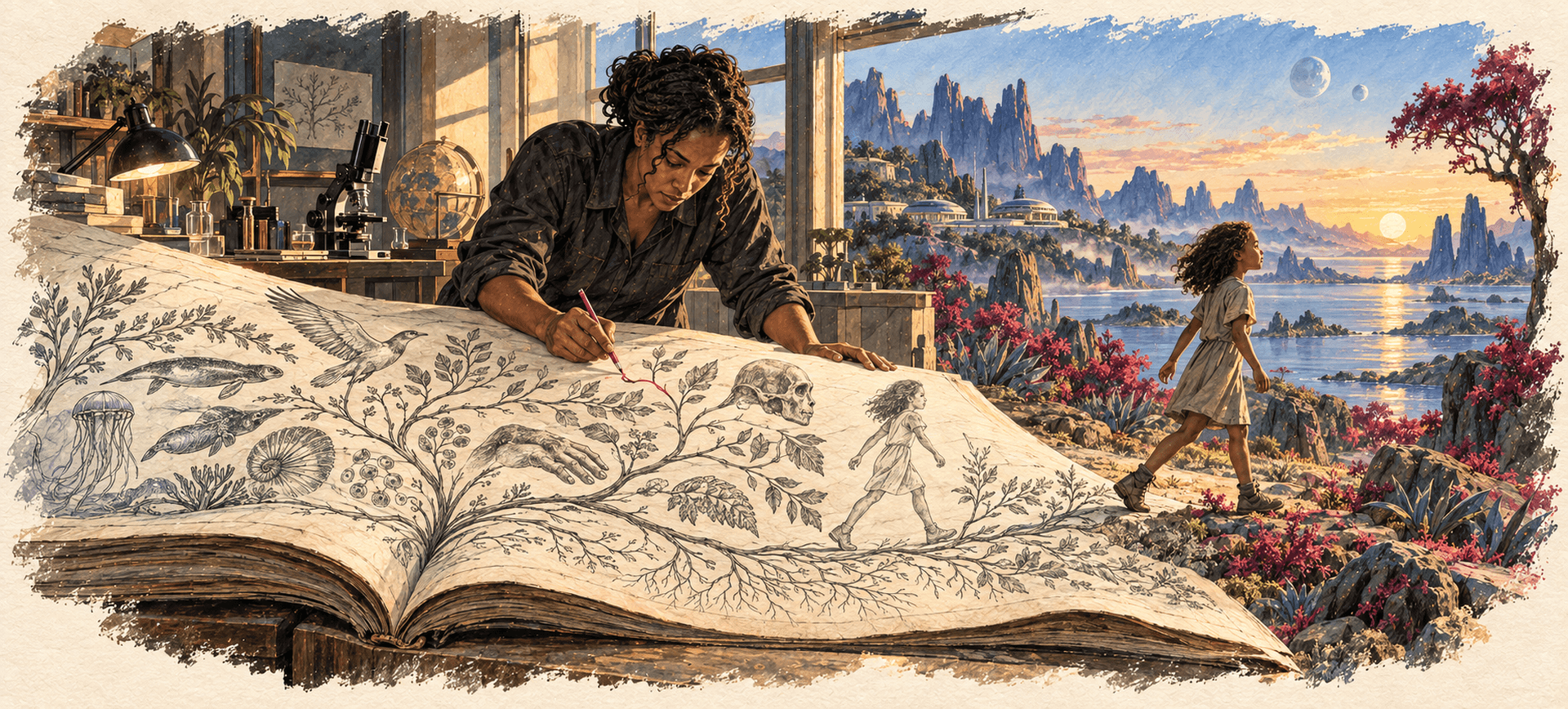
Every creation story I grew up with had a creator.
God shaped Adam from dust. Prometheus worked in clay. In Māori tradition, Tāne formed the first woman from the earth and breathed life into her. However the details changed, something with intention stood at the beginning of us.
Science removed the hands from the story.
Mutation supplied the possibilities. Selection kept some and discarded others. Time did the rest.
For nearly four billion years, that process had no rival. Life changed, sometimes radically, but nothing alive could examine the machinery of inheritance and deliberately rewrite what came next.
Until we came along.
Humans have been leaning on biology for almost as long as we’ve been human. We bred wolves until their descendants slept beside our children. We turned wild grasses into wheat and maize, shaped cattle around milk production, built horses for speed, and coaxed flowers into colors that would have been improbable in the wild.
Selective breeding still meant working from nature’s inventory. We could choose among the variations that appeared, encourage the ones we liked, and wait for another generation.
Genetic engineering let us place an order.
In the early 1970s, scientists learned how to cut DNA from one organism and insert it into another. Almost immediately, some of the people doing the work became worried enough about what they had built that they called their colleagues together.
In February 1975, scientists met at Asilomar on the California coast to discuss the potential hazards of recombinant DNA and establish rules for doing the research safely.
Asilomar happened before recombinant DNA had produced a catastrophe. The people closest to the discovery had simply seen far enough ahead to understand that they were handling something new.
For the first time, biology could be edited on purpose.
For most of the next forty years, genetic engineering demanded enough money, equipment, expertise, and patience to keep the number of people capable of doing it relatively small. Difficulty served as its own form of containment.
Then CRISPR arrived.
CRISPR was extraordinarily powerful because bacteria had already invented much of the machinery. They had been cutting genetic material for ages. We learned how to choose the address.
In 2018, He Jiankui announced that twin girls had been born from embryos whose genomes he had edited.
The scientific world condemned the experiment. The World Health Organization assembled an expert committee on human genome editing and declared that proceeding with clinical applications of germline editing would be irresponsible at that time.
The condemnation could not reverse the experiment. A question that had belonged to philosophers, ethicists, and speculative fiction now had two living answers.
Humans could alter the inherited genetic code of future generations because someone already had.
Five years later, in December 2023, the FDA approved Casgevy for sickle cell disease. CRISPR had produced its first approved therapy in the United States.
This time we celebrated.
And we should have.
A mutation that causes terrible suffering could now be countered by deliberately changing the biology of a patient’s own cells. The same revolution that frightened people when applied to an embryo could save someone’s life when applied to disease.
This is where the cleaner dystopian versions of the story fall apart. Casgevy does not tempt us with some abstract promise of progress. It gives people with sickle cell disease a chance to live without recurrent crises of pain.
The danger enters carrying proof that it can help.
The danger enters carrying proof that it can help.
In 2022, DeepMind and EMBL-EBI released predicted structures for more than 200 million proteins, covering nearly every protein then catalogued by science. Generations of structural biologists had spent years determining individual protein structures. AlphaFold gave researchers something close to an atlas of the protein universe.
In March 2024, surgeons at Massachusetts General Hospital transplanted a pig kidney carrying sixty-nine genomic edits into a living human.
No version of evolution had prepared that organ for him. We had altered the animal until the kidney could cross the distance between species.
Each breakthrough presents its strongest argument in the life directly in front of us. A patient in agony. Someone dying while a transplant list moves too slowly. A family carrying an inherited disease. Farmers watching drought take the harvest.
Faced with the person who can be helped now, the possible consequences two generations from now have trouble getting into the room.
I work in this world. Much of my career has been spent trying to accelerate technologies like these because I believe deeply in what biotechnology can do for humanity.
My confidence in biotechnology is exactly what makes its consequences worth taking seriously. These technologies will spread because they will solve real problems for real people.
But what happens after the solution becomes indispensable?
Medicine will shade into enhancement. Adaptation will become design. We will begin by treating conditions that threaten human lives and eventually find ourselves altering the conditions under which a life still counts as human.
Nobody will ring a bell when we cross that line.
Humanity will never take a clean vote on whether to direct its own evolution. We will make that decision one emergency at a time: a sick child, a failing organ, a pathogen we cannot stop, a climate our bodies cannot tolerate, perhaps eventually a planet where Earth’s genome is poorly equipped for survival.
Each intervention will answer the emergency in front of us. Together, they may answer a much larger question nobody remembers agreeing to ask.
That is the pressure chamber Sean and I built for Echoes of Tomorrow.
At its center is a geneticist whose diagnosis of humanity’s problem is entirely correct.
Dr. Samara Makinde is part of a human colony trying to survive on DaVinci, a world that does not care whether the people who landed there are genetically equipped to live on it.
They aren’t.
DaVinci has its own biology, ecology, and rules. The colonists arrive carrying a genome written by conditions on Earth, and no amount of human determination can make that genome fit a world that never participated in writing it.
Samara sees the problem clearly.
If humans cannot adapt to the world quickly enough, then the humans need to change.
So she changes them.
Samara acts because extinction is the only alternative she can see. Her love for humanity gives her the nerve to redesign it, along with the certainty that she has the right.
Across four books, the series follows technologies capable of saving humanity far enough to discover what they require in return. The problem becomes more uncomfortable with every success:
What happens when the technology works, but the people using it disagree about what success means?
If you alter a human genome so a child can survive somewhere her parents cannot, have you saved humanity?
Or started something else?
If her children inherit those changes, when does adaptation become speciation?
If an android loves, fears death, sacrifices itself, remembers the people it has lost, and asks to be treated as a person, how much biology does humanity require?
If a human consciousness can be copied, repaired, extended, and revised, which version retains the right to call itself the person?
Once someone can answer these questions for everyone else, what possible limit survives the threat of extinction?
Synthetic Eden starts with the smallest unit capable of carrying the entire argument: a mother deciding whether to alter her daughter’s genome because the alternative appears to be death.
From there, the aperture widens.
In Hubris Rising, Divine Blueprint, and Genesis Undone, that private choice keeps acquiring new owners. Families inherit it. Religions interpret it. Governments try to control it. Artificial minds and engineered species begin making claims of their own.
The argument stops being about whether one scientist had the right to change one genome.
It becomes an argument over who owns the future of a species.
It becomes an argument over who owns the future of a species.
Naturalists, geneticists, machines, and political visionaries all claim some portion of that future. Each can explain what must be protected, what can be sacrificed, and why the authority should belong to them.
We wanted every side to possess enough truth to become dangerous.
The technologies most capable of changing humanity will arrive with clinical data, regulatory approval, and photographs of the people they saved. Every success will strengthen the case for the next intervention.
By the time someone thinks to ask what we have been preserving, the answer may have changed.
For most of human history, evolution happened too slowly for an individual person to watch. That may no longer be the world we are entering.
Artificial intelligence helps us understand biology faster. Genetic engineering lets us alter what we understand. Synthetic biology approaches living systems as design problems, while medicine replaces functions evolution produced with versions chosen in a laboratory.
Every advance increases the reach of the others. The distance between understanding life and redesigning it keeps shrinking.
Echoes of Tomorrow follows that momentum past the point our own world has reached. Biotechnology keeps solving the immediate problem until survival itself becomes an act of engineering.
By the end of the series, asking whether we should change human beings feels almost quaint. Humans have changed. Naturalists, geneticists, machines, and the altered descendants of Earth are fighting over authorship of whatever comes next.
For four billion years, evolution wrote every draft without an editor.
Now humanity can revise the manuscript while we are still living inside it.
Evolution has competition.
Echoes of Tomorrow is co-authored by Alexander Titus and Sean Platt, and is available at booksellers everywhere.