The first story I remember reading featured Grover, panicking as he begged me not to turn the page in There’s a Monster at the End of This Book. I have been turning it ever since.
Fuck McDonald’s for creating one of my core memories, but the next book I remember came with fries. Mom raised us to hate the establishment, loathing Ronald McDonald, a character she regarded as a child-luring fever dream in mustard-colored overalls. But she loved their fries, so every once in a while we would go through the drive-through on the condition that we lied about it to Pop when we got home.
According to the brief window when McDonald’s was giving away copies of The Adventures of Tom Sawyer, I could not have been older than three. The cover of that version showed the fence half whitewashed, Tom in the middle of talking some other kid into finishing it. Something about that image lodged early.
I am a producer. I make books, story worlds, films and an unreasonable number of other things. I never work alone.
Every good or bad thing that’s ever happened to me eventually appears in a story.
I was five when I found my mother’s copy of The Hobbit in the garage and read the whole thing. Then, at eight, hot off the presses and still in hardback, I lifted Stephen King’s The Talisman off her nightstand. My world was never the same.
I was on the payroll before I was on a bicycle.
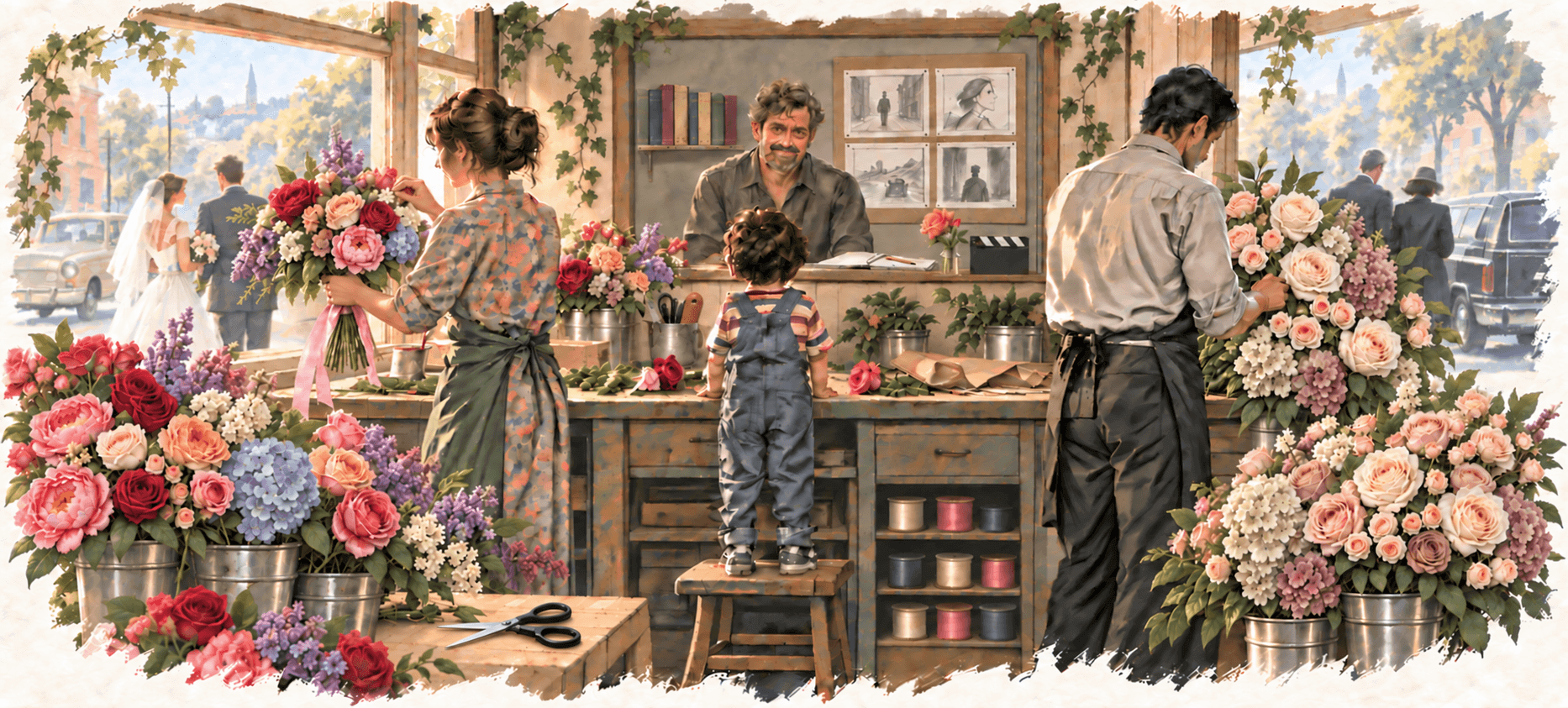
My family owned a flower shop in Long Beach called Rainbows, and I grew up behind the counter, where people walked in on the best day of their life and also the worst one. Weddings, funerals, and a great many apologies, all sold by the stem.
Our shopping center had a Waldenbooks. The college kids who ran it let me read whatever I wanted while steering me toward things I never would have found on my own. Comics and graphic novels, Dragonlance and Mark Twain, Blanche Knott’s Truly Tasteless joke books and Encyclopedia Brown. By the time I turned twelve, I had read everything in King’s catalog. Spending most of sixth grade in hallway detention gave me ample time to finish It.
But books were never my first love. That affair belonged to film and television. The same shopping center that harbored Rainbows had a United Artists theater. AMC was across the street. My sister and I either went to the movies on Saturdays while our parents were at work, or spent the day at our grandparents’ in South Central Los Angeles getting lost in hours of TV. On most Sundays we went to the movies as a family; that was our church. Mom was addicted to VHS, adding a tape or two every time she went to Target.
TV and movies were made by a room full of people. That reality nested inside me early and never came out.
TV and movies were made by a room full of people. That reality nested inside me early and never came out.
Kurt Cobain died in April of 1994. Two weeks later I fucked off out of high school and went to work full time at the shop while I figured out what business I wanted to open first. For most of that year, the answer was a hot dog cart in downtown Long Beach.
But in 1995, two employees my family trusted with everything stole our accounts and opened a rival shop a mile away. Treachery is an excellent motivator. I tripled down and took Rainbows to five locations in three years to squeeze them.
In 1997, a regular customer who had been buying copious amounts of flowers for a few months handed me her business card and said, “Call me for coffee sometime; I’m going to go broke doing it this way.” Her name was Cindy. She started calling me the Godflower. She also started telling me I should be writing, a suggestion I ignored for the next ten years of our life together.
Nineteen ninety-nine was the best year in cinematic history. The Matrix, Fight Club, The Sixth Sense, Magnolia, the list sprawls from there. I spent that year falling deeper in love with stories and with Cindy while writing movie reviews that were read only by me.
Our daughter was born in 2002 and cracked my world open.
Time turned fragile. Everything started looking like a story waiting to be told. Cindy insisted I start writing.
“I don’t know where the commas go,” I said, like always.
In 2005 we opened a preschool, swapping our steady gigs for chaos, laughter, and just enough money to get by until our children started elementary school. Cindy thought writing might be my next chapter. I still wasn’t ready to believe her.
On my thirtieth birthday, she bought me a MacBook we couldn’t afford and told me to use it. I ran the comma line one last time.
“You’re a storyteller,” she said. “Editors will know where all the commas go.”
I finally listened, taking rest time to write each day. Four months later I had a godawful draft of my first book. But I’d taught myself that I could stay ass in seat and produce something at the end of it.
I turned my attention to something simpler, writing for the children in our preschool instead. After I had gathered enough poems to call the collection a book, I sent my rhymes to an agent. Thirteen weeks later, a publisher told me that my “vocabulary was too rich for children.”
So I decided to build my own audience instead, however long that was going to take. I started on July 17, 2008. Two weeks later I met a guy named Dave, and we started collaborating almost immediately.
I Am a Writer
But dreams don’t cover the mortgage, so I started writing SEO articles, the dead skin of the internet, for a penny a word.
Copyblogger was the place to land a guest post at the time. Writers were begging for space on the page. The founder read something of mine and invited me. I went out of my damn mind when his email hit my inbox. I was upstairs writing in an unfinished room of our fixer-upper, paint peeling off the walls behind me while I typed through rest time. I ran down the stairs screaming. Cindy told me to chill.
The post was called I Am a Writer. Hitting publish felt like screwing a brass plaque onto the door. I had spent a year wondering whether I was allowed to use the word, and now the declaration was sitting there in public with my name underneath it.
It felt so right at the time, but over the years I realized how poorly that word described what I did, or who I was. Writing is one of my strongest tools, though it turned out to be one lever on a much larger console.
Copyblogger sent me a box of books for Christmas that year, still 2008. Kennedy, Sugarman, Ogilvy. All the OG copywriters that the online guys were aping. I devoured them all and bought myself another stack, learning to write in a way that launched my rate from a single cent to a dollar per word.
The owner of a marketing agency, Lori, saw something I wrote online and reached out to me. “You’re better than 95% of writers out there, but the last four percent is where the millions are made. How much would you need to work exclusively for me?”
I gave her an unreasonable number, and she agreed to the price.
Too late to save that fixer-upper, but early enough to change our lives. We moved to Cincinnati, and I became both creative director and consigliere, earning enough to wipe out our debt. Two years later, I had a full roster of clients.
I left a lucrative copywriting and consulting business for a big bet on stories.
In September of 2011, Amazon dropped the Kindle to $79 and blew the door off the early-adopter clubhouse. Everybody in publishing was arguing about whether this would last. I was counting the days until Christmas.
I had already looked into printing my own books and gotten priced out of filling a garage with copies nobody would buy. I knew how to tell a story, and I knew how to build an audience. Now Amazon was about to put a bookstore under millions of Christmas trees for $79 apiece. My window opened December 26, and I wanted as many stories as possible waiting when everybody unwrapped one and went hunting for something to read, while James Patterson’s publisher was still asking fifteen bones for a file you could buy cheaper in hardback at Target.
Dave and I had been writing together for three years by then, publishing a serial called Available Darkness online with a new chapter released each Friday. I wanted a story universe built for speed. Episodes and seasons in a sandbox big enough to keep running for years.
That serial became Yesterday’s Gone.
We never stopped. Between the first season and the second, Dave and I wrote shorts so that no week would pass without us publishing something new. I insisted that no church meets every other Sunday, taking my cues from television, where the nine o’clock slot never sits empty, and the week one show finishes there is already another one waiting for it. We dropped a fresh story every Tuesday.
Two or three weeks into our second season, a reviewer wrote that Tuesday was the new black, and I knew there was no going back.
From the beginning, I wanted a creative life bigger than my own pair of hands.
I founded Sterling & Stone that same year. Everything I make today still runs through what was once a publishing company and is now an incubator for more than two dozen storytellers.
Being a producer meant more worlds than I could ever write myself. I just needed to find the right people to help make them real, then stay out of the way.
The Beam was the first universe to test that theory. Set in 2097, America chooses every six years between a party that guarantees food and shelter and one that guarantees opportunity and nothing else. AI runs beneath almost everything, with a handful of people quietly holding the strings. Thirteen years later, the story feels uncomfortably prophetic.
I built the world, handed it to a writer, and learned almost immediately that my theory of producing had a hole in it.
I built the world, handed it to a writer, and learned almost immediately that my theory of producing had a hole in it.
Johnny B. Truant and I revisited it after Unicorn Western, and I realized that staying out of the way was the one part of producing I was terrible at.
Now I treat every story like a writers’ room. I decide what needs painting, find people who can make each part better than I could ever accomplish alone, and stoke their excitement enough about the fence that they want their own brush.
Three-year-old me would have recognized the arrangement.
Dave, Johnny and I started the Self-Publishing Podcast in 2012, mostly so we could argue about all of this out loud with microphones on. Two years later we wrote down how we worked and called it Write. Publish. Repeat.
That book put us on stages for years and pulled me deeper into teaching, where I stayed too long. Almost every headache and every expense in the business came from that side of the house, while all the fun and profit stayed lived in the fiction.
I came all the way back in 2021, after we stopped being a publisher and started taking the worlds we’d already built to studios and production companies.
2023 nearly ended me.
A writers’ strike in Hollywood, followed by an ethical and financial bankruptcy from our biggest client. Unpaid invoices, canceled contracts, and close to a million dollars gone out of the company inside a couple of weeks.
I have made a lot of money in this business, and I have spent nearly all of it on people. I would like to tell you I learned something after the flower shop. I did not.
Somehow my optimism survived with insulting ease.
A few of those worlds are in early development for film and television now, and I’m making more with the screen in mind from the beginning. Sometime in the next year or two I will be sitting in a dark theater or at home next to Cindy, watching the credits roll, and seeing Executive Producer under my name for the first time. I’ve been heading toward those two words since long before I knew they were a job, and I cannot wait.
For most of my life, the part of me that makes what I love and the part of me that knows how to sell it have been at war, and that war has cost me plenty. Producing finally gave them the same job.
I spent several years writing and publishing almost none of it, which felt like failure while it was happening but turned out to be me stocking a warehouse. Now I’m shipping a book or more every month, and there are still pallets I’ve yet to open.
Making whatever I want has been a terrible business decision. Readers like getting the same thing again with a difference, and my shelf looks more like a studio lot than an author brand. Horror on one soundstage, science fiction on the next, unicorns somewhere out back. For years I waited for a recommendation engine to figure out where I belonged. It never would.
So my stories are all here now, in one place, for the first time.
A post-apocalyptic serial that is now in its third iteration over fifteen years. A nun who fights crime like a ninja. A western where the six-guns belong to unicorns. A novel that opens on the morning the richest men alive start dying inside the security systems they bought to keep themselves safe.
They have nothing in common except me.
I grew up in Long Beach. I live in Austin now, with Cindy and a dog named Fisher. Our children are all grown and out in the world, but our nest is not empty. She no longer calls me the Godflower, and I still do not always know where the commas go.
Every series has a free book at the front of it. Take one, and start wherever you like.
The people who read these are Storykeepers. I will see you on Tuesday.