On February 1, 2013, Netflix put all thirteen episodes of House of Cards online at once, and told everybody who had spent a lifetime waiting for next week that next week had been canceled.
Television had trained its audience to make appointments. You got an episode, waited seven days, argued about it at work, and came back at the same time because NBC wasn’t going to hold ER until you finished dinner. Netflix removed the appointment and handed over the season like it was on a shelf at Costco.
Watching too much TV was already one of America’s core competencies. Cindy and I lost entire Sundays to VH1, bingeing the network’s onslaught of Behind The Music episodes. Netflix turned the binge into a release strategy, then gave the culture a better word for the weekend we just lost.
Every streamer that followed had to decide whether to copy it. Many did. Parrot Analytics, counting releases across the major American streamers, found that weekly outnumbered binge drops for the first time in 2021. By 2025 only about a third of shows arrived all at once.
Netflix never abandoned the binge because it had built too much of its identity around the promise that the next episode was waiting. The industry at large had more freedom. Disney+ opened on November 12, 2019, with one episode of The Mandalorian, then made the world wait seven days for more Baby Yoda. Apple took the same approach with its shows. Both companies watched a conversation that might have burned through a weekend last for two months instead.
Netflix eventually hedged at the edges of its own model. The fourth season of Stranger Things arrived in two pieces, with seven episodes on May 27, 2022, and the final two on July 1. The Duffer brothers pointed to the size of the season, including a finale that ran two and a half hours. Business reporters noticed that the two halves landed in different financial quarters, giving anyone who subscribed in May a reason to remain subscribed in July.
The analyst Zak Shaikh put it plainly at the time:
Bingeing worked as a strategy to disrupt the marketplace. But it doesn’t maximize the value of hot properties.
Binge and weekly releases ask the audience for different behavior. A binge can take possession of an entire weekend and create the sort of cultural pileup that makes everyone afraid to open social media until Monday. A weekly schedule gives the story time to become part of somebody’s life, then gives the service seven days to make sure something else is waiting when the season ends.
Fifteen months before House of Cards, I tried my version with an apocalypse. Amazon dropped the price of a Kindle to seventy-nine bucks in September 2011, and I knew that millions of people were about to unwrap empty bookstores and go looking for something to put inside them. Dave and I published the first episode of Yesterday’s Gone on Tuesday, October 25, then returned the following Tuesday with another. A small army of writers told us serialization was what you did when you couldn’t finish a book and that readers would punish the cliffhangers because nobody would wait around for the next part.
I rejected the theory. We wrote short stories between seasons so the space would not go dark. Television had taught me that the nine o’clock slot never sits empty, and the week one show finishes another one should already be waiting for the chair.
Dave and I kept that schedule with religious conviction until the business pulled us in other directions. Then we spent a decade writing for the machine instead of the appointment, chasing whatever the store was rewarding that quarter. My conviction came and went. The idea never left.
A story is worth more when readers know when to look for the next one, and I’m done renting that appointment from a company that can change its machine without telling me.
I’ve published hundreds of books and, somehow, never had an author site. I had company sites, launch pages, retailer listings, and enough domains that GoDaddy sends me flowers on my birthday. But I had never built one place around the relationship between my stories and the people reading them.
Once I started, author felt too small for what the place needed to hold. I still write, but I also commission, collaborate, develop, package, and adapt. Producer fits the work better, and a producer needs more than a handsome résumé with a row of retailer buttons underneath it. The site should behave like a streamer.
A streamer has four things working together, and only one of them is the shows. It has a shelf deep enough to disappear into, a schedule you can set your week by, a slate that lets tonight’s story point toward the one arriving next, and a single relationship covering all of it instead of thirty separate transactions.
Most author sites record what the author has done, link somewhere else to buy it, and politely suggest coming back sometime. I cannot imagine many evenings getting lost inside one. I want a reader to arrive because somebody recommended a book, then learn within eight seconds that there are five seasons of this world, another series connected to it, an adaptation in progress, and something new landing next week. That discovery is the reason people start one episode at eleven and remain on the couch at two in the morning negotiating with tomorrow.
Somebody has to program the place, deciding what premieres, what follows, which old series deserves a new front door, and how the finished thing points toward whatever comes next. For most of my career, I wrote the best story I could, placed it on somebody else’s shelf, and hoped the machine was in a generous mood.
That arrangement started to feel like asking a slot machine to babysit my catalog.
That arrangement started to feel like asking a slot machine to babysit my catalog.
I am building a home for everything I have already written and everything arriving next. I am working with more creators than I ever have, on worlds that outgrew my byline a long time ago. All of it needs one address, so a reader who finds one door can find the next one.
I started writing on the internet on July 17, 2008, for no better reason than it happened to be a few days after I got my first and only publisher rejection and decided to build something for myself instead of asking for permission. I found out much later that another storyteller had opened something on July 17.
Walt Disney used to sit on a bench in Griffith Park eating peanuts while his daughters rode the merry-go-round. He enjoyed watching them but hated that the experience had no place for him inside it. He began imagining a park where parents and children could inhabit the same story at the same time, which means Disneyland was born because Walt needed somewhere better to sit.
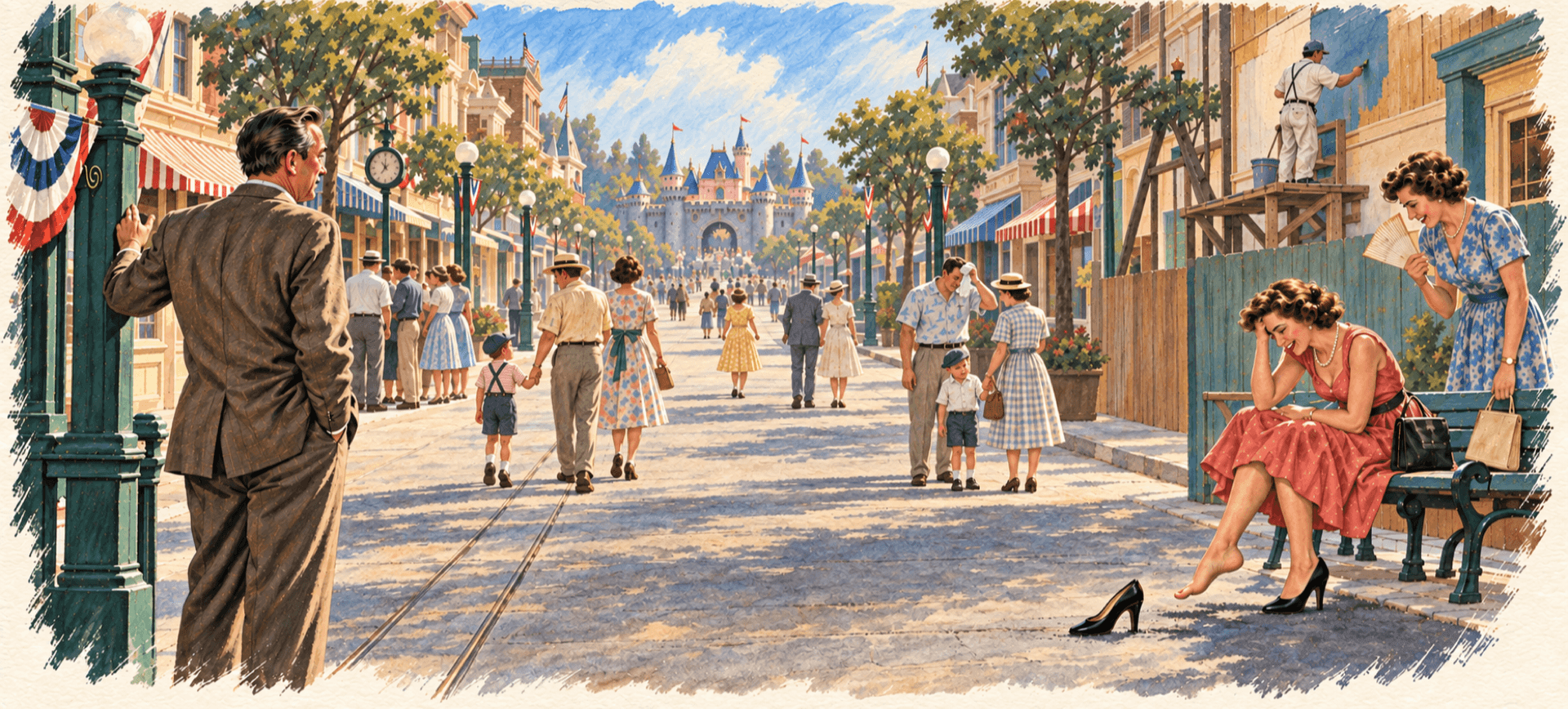
The park opened on July 17, 1955, and the day was a catastrophe. Fifteen thousand people were invited and more than twenty-eight thousand got inside, many carrying counterfeit tickets while a few scaled the fence using a ladder somebody had the entrepreneurial instinct to rent by the climb. Asphalt on Main Street had been poured that morning and softened in hundred-degree heat, leaving women’s heels stuck in it. A plumbers’ strike left the drinking fountains dry. The Mark Twain riverboat took on so many passengers that it listed, several rides never opened, and Tomorrowland looked as though tomorrow had missed its connection. The staff called it Black Sunday. Tens of millions watched the broadcast, and the millionth visitor came through the gate within seven weeks.
Walt told the press they would get the place operating properly, though it might take a month. For the rest of his life, he kept returning to the larger promise that Disneyland would never be completed as long as imagination lived in the world.
Some of the asphalt is wet, and if you walk through this week you may leave a heel in my metadata.
I am borrowing Black Sunday’s best excuse and asking you to pardon the dust. The site I’m launching this week is not finished, and I hope it never will be. Books are still going up while covers are being replaced, and descriptions I wrote a decade ago remain in places sounding exactly as old as they are. Some of the asphalt is wet, and if you walk through this week you may leave a heel in my metadata.
For fifteen years, stories I wrote lived on other people’s shelves, sorted by machines that were never going to understand a catalog like mine. A reader who loved one book could find the retailer’s idea of what came next, which was often sponsored, occasionally mine, and never obliged to understand the whole mess. I knew this and let it continue because building the alternative was hard while writing another book was fun.
Anyone can become a StoryKeeper for free with an email address. The first book in every world is free, and it always will be. Fifteen years of worlds, and you can walk into any of them tonight without paying me anything. Every Tuesday, I’ll tell you what’s new across these worlds, and every Friday I’ll send a new Letter about the stories behind the stories, or whatever notion nabbed my attention that week. Some weeks will bring a surprise I refuse to ruin by slipping it into launch copy.
StoryKeepers Plus costs ninety-nine dollars a year and opens my entire library. Everything with my name on it lives there in the order it was meant to be read, collaborations included, and everything new arrives early and is included with membership. Starting in January, Plus members will get a new short story every Sunday.
The first five hundred people who join keep the ninety-nine dollar price for as long as they stay, because the people willing to walk across wet asphalt should never pay more than the people who arrive after the paint dries.
Books are only the beginning. Some of these worlds will become things you watch or listen to, while others may be places you can step inside and move around. This shelf gives me room to make more, hire more people to help, and bring in creators whose stories should be standing beside mine.
Disneyland survived Black Sunday because opening the gate committed Walt to all the work that followed. The stories behind me should help pay for the ones ahead, and creators who join us should find readers already in the room. Some corner of the place should always be under construction because another story is making trouble backstage.
The asphalt is soft and the shelf is finally here. Take a book, pick a world, and I’ll see you Tuesday.
Sean Platt is a producer and the founder of Sterling & Stone. The first book in every one of his worlds is free.