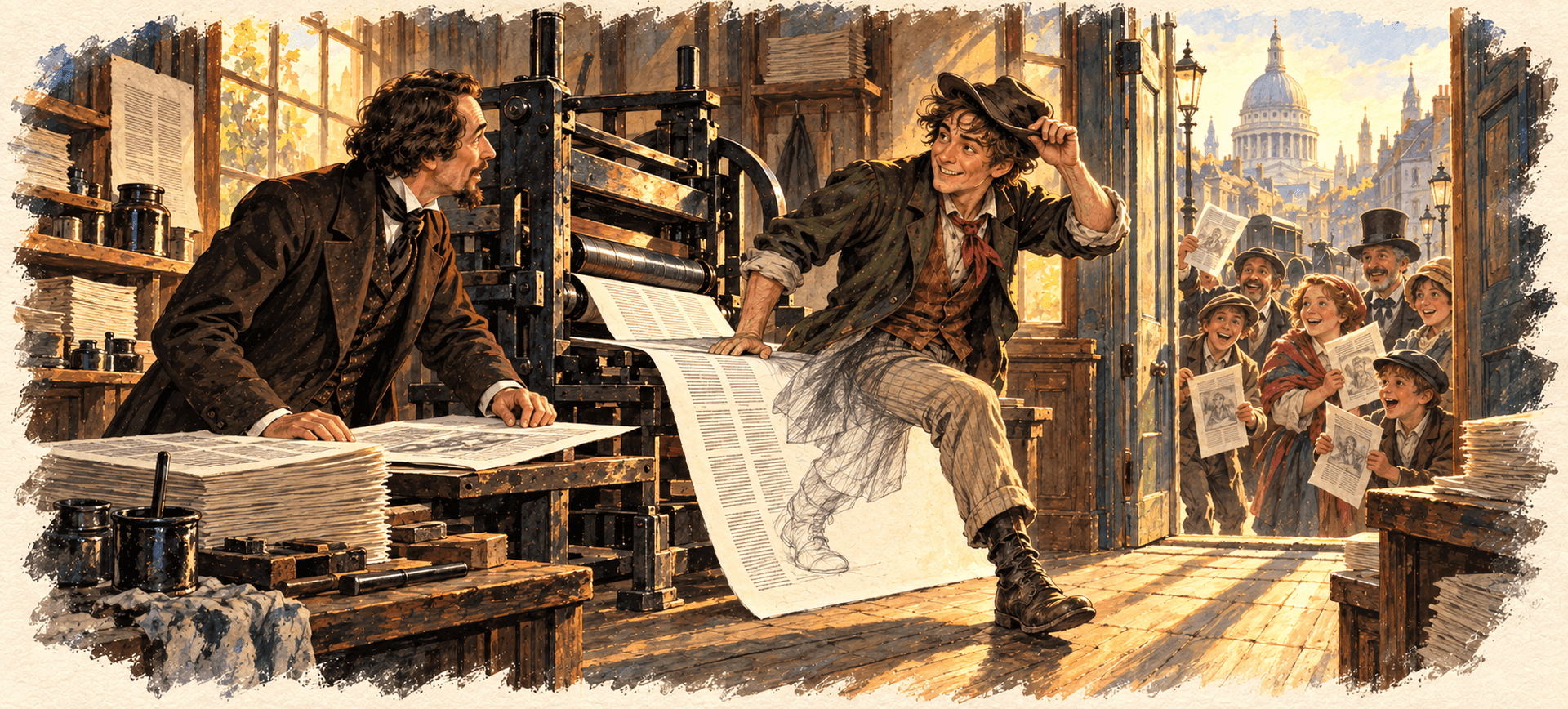
In March of 1836, Charles Dickens took a job that at least two more established writers had already turned down.
He was twenty-four years old, about to get married, and not yet Charles Fucking Dickens. He was a reporter who needed the money.
The assignment came from Chapman and Hall, a young publishing company looking for words to connect a series of comic illustrations by Robert Seymour.
Seymour had imagined a club of bumbling sportsmen getting into trouble. Dickens was supposed to provide enough prose to move them from one picture to the next.
The artist was the draw. The writer was the connective tissue.
The first installment of The Posthumous Papers of the Pickwick Club sold about four hundred copies.
Then Seymour died by suicide after completing the illustrations for the second installment.
There is no responsible way to turn that into a tidy anecdote about a struggling publication. But for Dickens it meant that a small assignment nobody particularly wanted had lost its originator. The project could have ended there.
Dickens took more control of the story and kept writing instead.
He introduced Sam Weller a few numbers in, a bootblack with a crooked grin, a bottomless supply of mangled proverbs, and better lines than anyone with a proper title.
Weller was not part of some grand blueprint. He arrived after publication had begun, when Dickens could still hear four hundred copies rattling around a mostly empty room.
Then Sam Weller blew the damn doors off.
The audience multiplied faster than publishers could counterfeit him. Weller joke books appeared. So did songbooks and collections of counterfeit Wellerisms. Publishers were selling knockoff Sam Weller material while Dickens was still writing the genuine article. By the final installments, Pickwick was selling around forty thousand copies a month.
Four hundred to forty thousand.
Nineteen installments across twenty months, with a double-sized finale. Dickens became famous before he finished his first novel, and Victorian publishing found the machine it would run for decades.
Oliver Twist, Nicholas Nickleby, David Copperfield, and Great Expectations all reached readers in pieces. The heavy object assigned by your English teacher came later, after publishers gathered the installments, bound them, and sold the story again.
First came the appointment. Then came the book.
I knew this history long before David Wright and I started publishing fiction together. I also grew up surrounded by proof that the serial had never gone anywhere.
Radio dramas sold soap between episodes. Television taught an entire nation to protect Thursday night. Comics waited for me on a spinning rack every month. Manga chapters ran weekly, then returned in collected volumes readers happily paid for twice.
Stephen King has been rearranging the furniture in my imagination for most of my life. In 1996, he published The Green Mile as six monthly paperbacks, giving each one its own shape and stopping where it hurt.
I didn’t need a business school to explain the model. I had been trained by Batman, The Twilight Zone, Stephen King, and forty years of television.
By 2011, everybody wanted another episode, and almost nobody was selling one as a book.
That year was an extraordinary moment for serialized storytelling. The Sopranos had already broken television’s moral compass and left its bloody pieces on the floor. LOST had ended the year before, after teaching millions of viewers to spend a week arguing about hatches, smoke monsters, and whether the writers had any idea what they were doing. Breaking Bad was in its fourth season while The Walking Dead was finding its legs and Game of Thrones had just taught America that top billing was not body armor.
Television was having a golden age because it trusted the audience with complicated stories, large casts, long memories, and protagonists who would have terrified a network executive a generation earlier.
Tony Soprano. Walter White. Don Draper.
People who had no business being the hero were suddenly the reason audiences were adding to the ass grooves in their sofa, week after week after week.
Publishing had spent a century moving in the opposite direction. The serial had helped build the modern novel, then the novel became an object that was supposed to arrive finished, and preferably thick enough to stop a door. Readers still loved anticipation, but the book industry had stopped selling it to them.
David and I had already tested the rhythm online with our first collaboration, a vampire/not-a-vampire story called Available Darkness. We dropped a new chapter for a waiting audience every Friday. We loved the deadline, the reader conversation, and the electricity of telling a story while people were waiting for more of it.
But our world changed on September 28, 2011 when Amazon announced a seventy-nine-dollar Kindle.
I saw Christmas morning.
At seventy-nine dollars, the Kindle stopped looking like a gadget for people who enjoyed explaining their gadgets. Millions of readers were about to unwrap one, turn it on, and go looking for something to read.
I had just under ninety days to make sure they found us.
Traditional publishers were giving us an opening wide enough to drive a Death Star through, charging $12.99 and $14.99 for downloads that sometimes cost more than the hardcover. Readers knew what had disappeared from the transaction. Without paper, printing, or shipping, they also knew when they were being charged extra to protect a system built for hardcover economics.
Indie authors discovered the other extreme. Ninety-nine cents became the price of admission. Cheap books climbed charts, and every copy created another chance to be noticed.
The visibility was irresistible. The economics were not.
I was not willing to write full novels for ninety-nine cents. But I did need a lot of products if I wanted those Christmas Kindles to keep running into our work.
I had David Wright and a plan almost every writer I knew thought was a terrible idea.
The kindest reactions were confusion. The rest was advice. Readers hate cliffhangers. You are training an audience to pay four times for one book and they will resent you for it. No agent, no foreign rights, no award will touch a serial.
And underneath all of it, said out loud by working novelists, the real objection: this is what you do when you cannot write a real book.
Every one of those warnings was about how the industry would receive it. Not one was about whether a reader would enjoy it.
Every one of those warnings was about how the industry would receive it. Not one was about whether a reader would enjoy it.
We would sell episodes for ninety-nine cents, because episodes could give us the visibility we needed. Then we would collect those episodes into seasons, because seasons could pay us like actual writers.
The math made the plan viable. Television gave readers two familiar words for what we were selling.
As far as we could tell, nobody on Kindle was building a fiction series using the language of television. We were selling episodes, not fragments. Creating seasons instead of chopping up a novel and asking readers to pay us repeatedly for the knife work.
The shorthand meant readers could understand our promise at a glance.
Every episode had to earn its ninety-nine cents before ending somewhere mean enough to make seven days feel unreasonable.
If we wrote a novel and broke it into six files, readers would smell the scam. A serial had to be designed as a serial. Dramatic cold open. Multiple storylines. A complete meal with something sharp hidden in dessert.
It also had to arrive on time.
Tuesday was when entertainment junkies went hunting.
New CDs came out. So did DVDs, books, games, and the week’s other cultural contraband. I had spent years walking into stores on Tuesdays to see what was new. We wanted our fiction to hitch a ride on that reflex.
So Yesterday’s Gone arrived on Tuesday, October 25, 2011.
Then another episode arrived the next Tuesday.
And the Tuesday after that.
Between our first and second seasons, we published short stories because we didn’t want the habit to cool. “No church meets every other Sunday,” as Dave got sick of me saying.
When a network ends one show at nine o’clock, another is already backstage getting powdered. We kept our slot filled.
A few weeks into our second season, a reviewer wrote that “Tuesday was the new black,” and we’ve been publishing on Tuesdays ever since.
We were also writing the story week to week, living one beat ahead of our readers. The audience couldn’t steer us, but we could hear them. They sent theories, fought in reviews, adopted favorites, and wrote to explain exactly what Dave had done wrong.
I forwarded those.
A finished novel meets its readers after every decision has been made. We were still making ours while readers stood one episode behind us, shouting guesses about where we were going.
That made the writing feel alive. It also turned yesterday’s lazy choice into tomorrow’s permanent problem.
If a novelist discovers in chapter forty that chapter four needs a gun in the drawer, the novelist goes back and adds the gun. If chapter four went on sale nine months ago, you had better find another weapon.
There is no fixing the old chapter before anyone notices. People already paid for it. They quoted it in reviews. They built theories on top of your throwaway line. Your accident belongs to the story now.
Discovery gets dangerous too. Somewhere near the end of a season, you may finally understand what the season has really been about. A novelist can return to page one and make that revelation look intentional. We had to make the revelation true using only what we had already published.
Sometimes that gave us an answer better than the one we would have planned. More often it gave David indigestion.
And every ending had to survive a full week.
A chapter can stop because the scene is finished. An episode has a harder job, following a reader through school pickups, staff meetings, bad sleep, dinner, television, and six days of other people begging for attention. By the time Tuesday rolls back around, that reader still has to care what is behind the door.
Seven days gave readers plenty of time to turn our clues into conspiracies.
Netflix shortened those seven days to fifteen seconds.
Netflix shortened those seven days to fifteen seconds.
When all thirteen episodes of House of Cards dropped the same day on February 1, 2013, people talked about bingeing as if streaming had discovered hunger. But a binge still depends on episodes. Each one needs to give you enough story to justify the hour while leaving you helpless against the button that starts the next one.
Dickens made readers wait a month. King made them wait a month. Television made us wait a week. Netflix gave us fifteen seconds to decide whether we still had plans.
Same appetite. Faster snacks.
Yesterday’s Gone begins on the morning of October 15, 2011. A man in New York wakes with a headache and notices that the numbers on his alarm clock have gone black. His apartment is quiet. He feels grateful because he has wanted an hour to himself for months.
He gets more than an hour.
Almost everyone on the planet has vanished. The people left behind must find one another across an empty country while whatever emptied it decides what to do next.
The King influence isn’t hidden. We grew up loving ordinary people forced to become extraordinary after the world stops behaving. We loved the scale of The Stand, the darkness beneath familiar places, and King’s willingness to let characters talk long enough for their loss to matter.
And Yesterday’s Gone has a lot of LOST in its bloodstream. An ensemble scattered by the impossible. Character stories interrupted by mythology. Answers that create more expensive questions. Cutaways placed with the emotional sensitivity of a car door closing on your hand. It was also a series Dave and I bonded over in the earliest years of our friendship.
Just when one character reaches the moment you have been waiting for, the story crosses the country to somebody having a much worse day.
In chapter six, it reaches New Orleans and a man named Boricio Wolfe. He wakes, understands that the world has ended, and drives across town to see whether the body he left the night before is still where he put it.
Boricio was supposed to make an impossible situation worse.
Readers took him and would not give him back.
He became our Sam Weller, the character who walked into a story already underway and changed its future. Boricio accumulated his own stories, collections, and fifteen years of mail from readers who wanted more of him, which says disturbing things about our readers and flattering things about David.
Boricio’s Gone had been in development for years.
What started as a ninety-day plan to meet a flood of Christmas Kindles has lasted fifteen years.
Six seasons. Three iterations. Hundreds of characters. More deadlines than either of us understood we were volunteering for, plus readers who remember details Dave and I have no memory of writing.
The first episode gave us a Tuesday deadline. The readers turned it into a promise.
We called them episodes because that was what we intended to deliver. We called them seasons because we intended to come back.
Now Boricio finally gets his.
Of course he does.
Sam Weller would understand.
Sean Platt is an author, producer, and founder of Sterling & Stone. He co-created the Yesterday’s Gone universe with David W. Wright.