Zombie stories have spent sixty years on the week the world ends. What happens the morning somebody announces it didn’t?
In 1968, George Romero shot a movie in western Pennsylvania about a man named Ben who survives the entire night. Ben makes the right call on the cellar, keeps his head while everyone upstairs loses theirs, and creeps up the stairs at dawn to the sound of men working their way across the field.
A posse is sweeping the county. One of them puts a rifle round through Ben’s forehead from the yard, and the credits run over grainy stills of the same men dragging his body onto a fire with meat hooks.
The first modern zombie movie ends with the cleanup crew, and the genre has walked right past it ever since.
The genre liked the night better than the morning.
Dawn of the Dead filled a shopping mall in 1978 and made the metaphor impossible to miss. Day of the Dead went underground in 1985 with the scientists and the soldiers. Danny Boyle opened 28 Days Later in an empty hospital. Robert Kirkman did the same for The Walking Dead, and for eleven seasons AMC ran the most reliable engine in cable television. The season five premiere in October 2014 pulled 17.3 million viewers, the most-watched drama telecast in the format’s history.
Money followed fixation. World War Z cost $200 million in 2013 and took better than $530 million worldwide, which still makes it the highest-grossing zombie film ever made, a record Guinness has gone to the trouble of certifying. Twelve years later HBO opened the second season of The Last of Us to 5.3 million American viewers on a Sunday night, thirteen percent above its own series premiere. Whatever else is true about this culture, it has not tired of watching the world end.
Collapse has better stagecraft. A horde hits the fence and every camera knows where to point. Cleanup arrives with respirators, subcontractors, invoices, and a form somebody will later deny knowing about. That material rarely makes the trailer.
The genre has spent six decades replaying the same five minutes: civilization breaks, people discover what they’re capable of under pressure, and somebody eventually finds the credits.
The camera almost always leaves when the paperwork arrives. That’s usually where I get interested, because real emergencies have terrible respect for endings.
Every emergency ends twice. Once when it’s over, and then again months earlier, when somebody with a podium decides it’s ended enough to stop talking about.
The second ending makes the news, and the first one belongs to whoever is still standing in it. Economists can put an end date on a recession while the unemployment office is still working through claims from people the recovery hasn’t found yet. A parole board calls it a risk score generated at intake, and that number follows a man out the gate whether or not it was ever right about him.
A city calls itself recovered the day a ribbon gets cut on the first rebuilt storefront, while three streets over somebody is gutting drywall by flashlight and waiting on an adjuster who has moved along to the next zip code with a worse news cycle attached to it.
A hurricane leaves the headlines several days before it leaves the town. Attention may be the only emergency service in the world that arrives on time and leaves early.
The criminal justice system prefers reentry, which sounds like a spacecraft coming home safely rather than a man walking out of a prison with a completion certificate in one hand and a box on every job application in the other.
Families have their own version. Every one seems to have a relative who got written off early and stayed that way. Nobody has ever filed an appeal against their own mother.
A company announces that it has right-sized for the road ahead. By Monday the org chart is current and every abandoned task is still sitting in somebody’s queue. The people who kept their jobs spend the next eighteen months discovering how much work can survive the employee who used to do it.
Cleanup has always had a labor market. Once the podium gets packed away, the shovel goes to whoever needs the paycheck enough to take it. Job descriptions become remarkably flexible after the signature dries.
We’re excellent at declaring things over. We throw parades for the end of a crisis that has yet to end, then act surprised when the people still inside it decline to clap along.
I assumed fiction would have to exaggerate that arrangement. Then I went looking.
History had already done the ugly draft.
On September 18, 2001, Christine Todd Whitman, running the Environmental Protection Agency, told New York the air was safe to breathe. Fifteen years later she said publicly that she had been wrong, and that she was sorry. By that point more than thirty-seven thousand people were officially recognized as sick from what they had breathed at the pile. Many were ironworkers, sanitation workers, laborers, and other people who came because the work needed doing and the money was there.
The word safe was already in the archive while people who had heard it were still breathing what would make them sick.
The word safe was already in the archive while people who had heard it were still breathing what would make them sick.
The word carried this argument long before Romero gave it a farmhouse. Haitian zonbi traditions are more complicated than the monster Hollywood eventually exported, but one recurring horror was brutally simple: a person stripped of agency and kept for labor. Scholars have long read that figure through Haiti’s history of slavery, where death had a rival nightmare, a body still working after ownership had swallowed the person inside it.
American readers encountered a sensationalized version in William Seabrook’s 1929 The Magic Island. Three years later White Zombie put Bela Lugosi over a Haitian sugar mill worked by the undead. Hollywood kept the vacant eyes and the shuffle. The labor disappeared into the costume.
The discarded piece is the one Bodywork needed.
Some of the genre has been drifting this direction for years. Max Brooks wrote the World War Z novel in 2006 as an oral history assembled a decade after the war ends, with an entire section on the crews clearing North America room by room. 28 Weeks Later opens with the United States Army declaring the British mainland safe and moving families back into a secured district of London, which goes about as well as you would expect. In the Flesh gave the condition a clinical name, Partially Deceased Syndrome, medicated its patients and mailed them home to neighbors who had hunted them.
Even there, the cleanup crew mostly stays at the edge of the frame. Somebody is still dragging the body off the road after the scene has moved on.
Bodywork follows that person home.
The camera has been creeping past the impact and into the aftermath for twenty years. But almost nobody follows it the rest of the way down, to the contractor clearing the road.
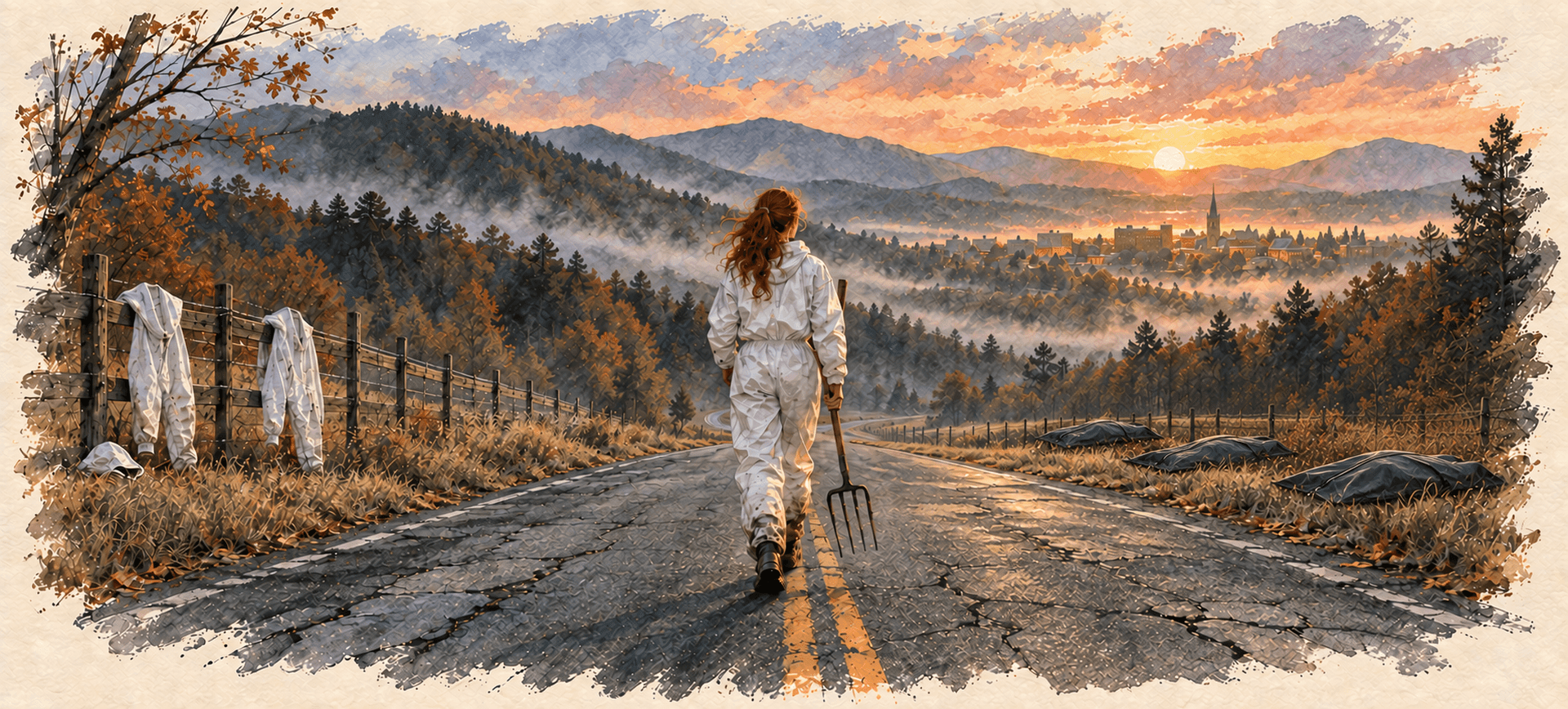
Bodywork starts on Route 103, weeks after a drug called Necrophage did something almost rude to the genre: it worked. The outbreak stopped early enough for bureaucracy to survive it. Quarantine lifted two weeks ago, though hardly anyone has come outside yet.
Panacea concentrated its official crews in the cities and offered cash to anyone willing to clear the backroads. More than a hundred thousand people signed up. Fewer than five thousand are still doing it.
Rita Hicks is one of them, working the shoulder in a Tyvek suit with a pitchfork, because pitchforks are easy to come by in Bledsoe and the contractor didn’t supply anything better.
My co-author Sawyer Black gave one of the men on that road the best line in the book about it. He had never trusted anybody who needed quotation marks around helping.
The job has an official term for where a person stops. The inflection point. Past it, the body is cleared as a threat. Ask where the point actually sits and the answer moves with whoever is holding the clipboard, which would matter less if Rita weren’t holding a pitchfork.
Then Rita rolls one corpse off another and hears a voice underneath. A girl has been pinned there, conscious enough to beg her not to finish the job. Her coworker takes one look and decides she is too far gone. Rita keeps looking.
“She’s not a thing.”
Minutes later, Panacea wants to know about the girl’s hair and the necklace around her neck. When the answers line up with something in their files, the institution measuring her as biohazard discovers a cash value.
Seventy-five thousand dollars, alive.
Halfway through the novel a priority bulletin comes over a deputy’s radio while a man stands there bleeding from a bite a cleared corpse just gave him. Panacea has received isolated reports of residual motor activity among previously neutralized subjects. Incidents have been attributed to postmortem muscular contractions, animal interference, or contractor misidentification.
Sherman Pope (the zombie virus) remains contained.
Rita has been on the wrong side of somebody else’s category since childhood. Her red hair answered a question Mama never wanted asked, and the family story took care of itself from there. Emily belonged. Rita explained what had gone wrong.
She’s spent her whole life living under somebody else’s verdict. On Route 103, the ugly novelty is that she gets to issue one.
The shelf I want more of starts after the sirens, when catastrophe gets translated into coverage limits, case numbers, and somebody else’s shift.
The shelf I want more of starts after the sirens, when catastrophe gets translated into coverage limits, case numbers, and somebody else’s shift.
An adjuster walks through a kitchen with the waterline still visible above the cabinets and decides which ruined things qualify as flood. Somewhere else, a wildfire moves from seventy-one to seventy-six percent contained while a family from the burn scar is still sleeping in a Walmart parking lot. A shelter loses its funding, so a caseworker has to make self-sufficient become true in a dropdown menu. Hospitals have their own version: CASE CLOSED on the paperwork, four years of stairs waiting at home.
The monster in those stories has office hours. It lives inside coverage language and eligibility rules, where nobody has to bare teeth to ruin a life.
Romero put the posse in the field for the last four minutes of 1968 and rolled the credits over men with meat hooks cleaning up a night everyone else had survived.
The apocalypse got canceled, but nobody canceled the cleanup.
The girl’s still screaming when the chapter ends. Nobody told her the emergency is over.
Bodywork is co-authored by Sawyer Black and Sean Platt and takes place in the world of Dead City, created by Sean Platt and Johnny B. Truant.