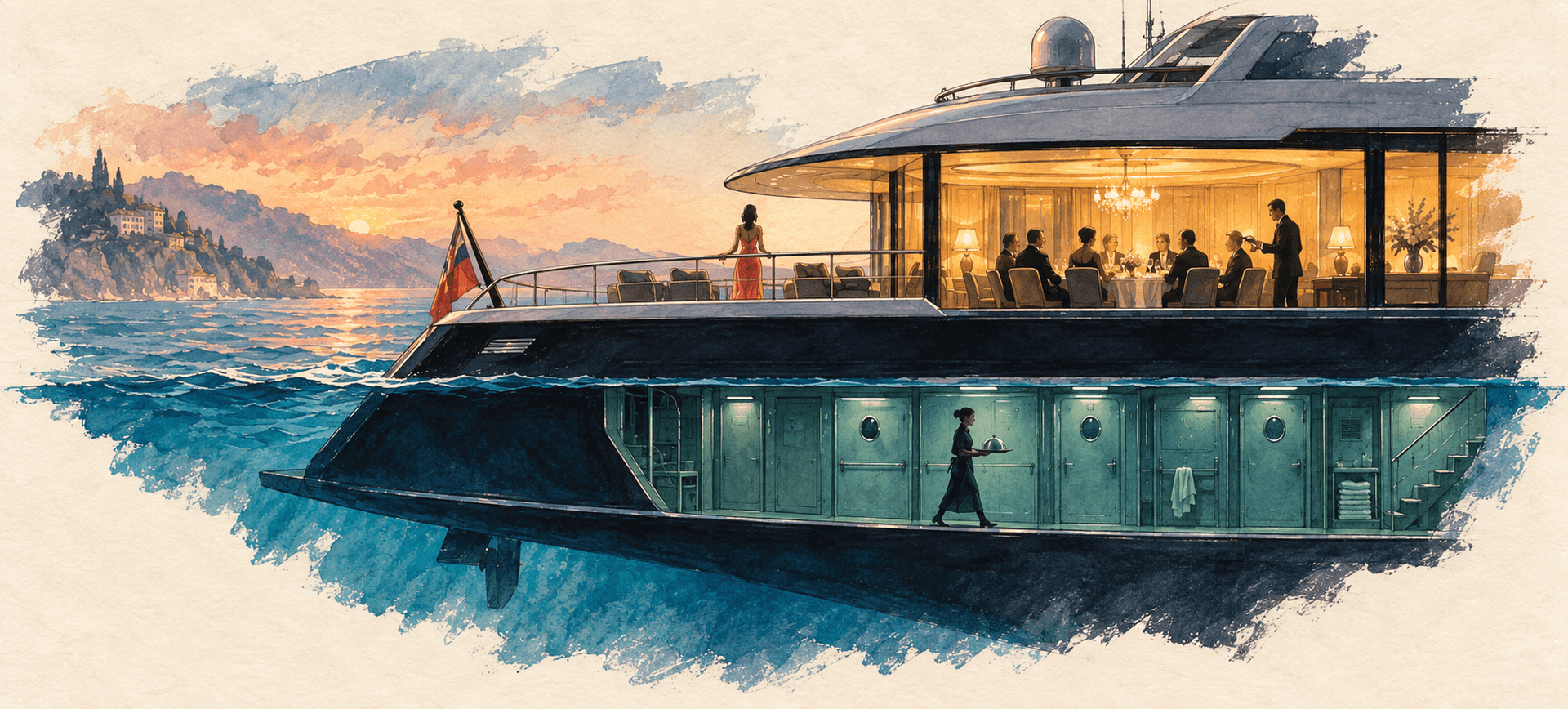
Rich people have been getting murdered in beautiful places for nearly a century. We may finally have figured out why we enjoy it so much.
In 1937, Agatha Christie put a boatload of rich people on the Nile and killed some of them. Depression era readers found this delightful.
Christie had already executed this trick on a train. Two years later she waved her literary wand on a private island, and that book became the bestselling mystery novel of all time. Nobody called these luxury thrillers back then. The label took another eighty years to arrive, and by the time it did, the shelf was groaning under the weight of every trust-fund alibi publishing could invent.
Christie didn’t set out to build a genre. She found the old upstairs-downstairs story lying around English fiction, sharpened it, and noticed something useful: the people making the beds tended to survive the people sleeping in them.
Christie inherited her venue from the Victorian country house, and the country house came with staff. Golden age mysteries kept servants on every suspect list, and the reason ran deeper than plotting. A household of help meant a household of witnesses, people who carried the trays and changed the sheets and heard every raised voice through doors built thin on purpose. And because the rich didn’t pay much attention to the staff, they could be impersonated.
The butler-did-it joke has outlived nearly everything else from that era because it identifies a real anxiety of the class that coined it. The help saw everything. Polite fiction found it easier to make them guilty. The honest alternative meant admitting how much they knew, and what all that knowledge might someday cost.
Sometime in the last century, the country house turned into the haunted house, and the turn came when readers stopped trusting the people who owned the place. A haunted house is stunning property with a permanent memory. The house remembers what its owners paid everyone else to forget, and whoever mops its floors hears it talking at three in the morning.
Put that house on water and the transformation finishes a job the country house only started. A superyacht has the locked rooms, the corridors guests never see, the staff trained into invisibility, and one upgrade no manor ever managed: this house can sail past jurisdiction. The ghosts on this boat were never dead. They’re crew, and they signed something with an arbitration clause.
I write and sell commercial fiction for a living, which means I spend an unhealthy amount of time absorbing what audiences are asking for and guessing which decade’s guilt they’re about to relive. Across a century of crime publishing, one pattern keeps surfacing on repeat.
Every time the distance between the dining room and the kitchen gets embarrassing enough, murder fiction seems to develop expensive taste.
Christie’s golden age ran straight through the Depression, when a country that couldn’t afford lunch lined up around the block to watch the wealthy get poisoned over dinner.
The eighties put money under hot lights. Dynasty turned the mansion into a contact sport. Wall Street gave greed a wardrobe and a catchphrase. Fatal Attraction discovered that even adultery looked more dangerous when everybody involved had beautiful countertops. Robin Leach spent ten years taking American television through the front doors of houses most viewers would never enter unless they were carrying a tray. Wealth went from scenery to production design.
The nineties made the fantasy stranger. Money was still sexy, but now the rich guy might want your wife, steal your identity, ruin your law career, or invite you to Italy and make you regret owning a passport. Indecent Proposal, The Firm, Basic Instinct, The Talented Mr. Ripley. The decade kept handing ordinary people access to beautiful rooms and then charging admission in blood. By then the modern luxury thriller had a foundation and a roof, just waiting for its name on the mailbox.
Then 2008 happened. The yachts came back faster than everybody’s houses did. A decade and change later we were locked indoors during a pandemic, scrolling photographs of infinity pools while the richest people on earth appeared to be having an entirely different emergency. By then the luxury thriller had plenty to work with.
Look at the shelf today. Lucy Foley marooned a wedding party on an Irish island and sold millions. Ruth Ware locked her heroine on a luxury cruise where the passenger list refused to add up. Knives Out earned its creator Rian Johnson a $450 million Netflix deal with its first sequel set on a Greek island owned by a tech billionaire.
BookTok has basically invented its own Dewey Decimal system for this stuff, tags that mash up homicide with interior design like nobody finds that combination insane. Booksellers used to slap “beach read” on a cover and call it a day. But the beach read grew teeth somewhere along the way, and the teeth made for a much better pitch.
Hollywood caught the same bug. Triangle of Sadness put a luxury cruise through a storm of biblical seasickness and came home with the Palme d’Or for its trouble. The Menu spent that same year plating its own guests, course by course. Kenneth Branagh sent Poirot back down the Nile that same February, for those of you keeping score at home. The White Lotus turned one resort chain into a returning anthology, a fresh cast of terrible guests checking in every season like it’s a haunted house with a concierge. And when Succession finally ended, the internet treated a fictional boardroom vote like Game Seven.
A locked luxury venue does something no courtroom on earth manages. Money’s oldest superpower is the exit.
A locked luxury venue does something no courtroom on earth manages. Money’s oldest superpower is the exit.
The lawyer, the settlement, the chartered flight that leaves within the hour, the publicist who makes the story disappear before dessert. Then a storm rolls in, or the anchor drops somewhere past cell coverage, and every exit money ever bought slams shut for the weekend, phone lines included.
What remains on board is a suspect with better luggage.
Readers understand the trade instinctively. We will forgive a plot a great deal if it promises the one thing courts rarely deliver, which is a rich person forced to stay in the room and answer the question.
The more interesting change is who gets to tell us what happened. Christie’s detective arrived as a guest and left as a guest. Patricia Highsmith spent the fifties on another approach, sending Tom Ripley to climb inside a rich man’s life through the skin. Jackie Collins ran a version of the same con through the eighties from the other side of the velvet rope, planting Lucky Santangelo in rooms real gossip columnists couldn’t get a badge into.
The eighties handed readers the keys and let them drive the wealth around for four hundred pages, which is why those novels read like catalogs you were allowed to bleed on. Gone Girl walked the genre into the marriage itself. And over the past decade the camera has been sliding down the table, seat by seat, until it settled on the person refilling the glasses.
Whoever holds the tray sees the entire room, and audiences have worked out that the tray is the best seat in the house.
The White Lotus opens on employees bracing for the arrivals, and The Menu belongs to its kitchen from the first plate. Bravo had already spent a decade running the experiment on Below Deck. For a century these stories asked us to see the mansion through the people sleeping upstairs. Lately we’ve started following the person carrying fresh towels through the service entrance, because it turns out we trust their account of the mansion more than we trust the people who own it.
Meanwhile, the word billionaire changed jobs. Thirty years ago it named an aspiration with a tax bracket. Today it functions closer to an accusation, and the people it describes keep supplying the evidence. They shoot themselves into low orbit. They buy islands and then purchase the silence around the islands. One bought Twitter on a whim and renamed it after a letter of the alphabet. Fashion spent a recent cycle teaching everyone the phrase quiet luxury, the art of dressing so expensively that only money recognizes money. Thrillers pulled up right behind it.
A millionaire still exists on a scale the human brain can picture. A nice house, a boat, retirement without checking the thermostat. A billionaire has left the neighborhood entirely. A million seconds is about eleven days. A billion seconds is nearly thirty-two years. The extra three zeroes look harmless on paper, but in reality they’re where wealth stops buying things and starts rearranging the world around itself.
In 2014, French economist Thomas Piketty published nearly seven hundred pages about wealth piling up faster at the top than everybody else could earn it. Capital in the Twenty-First Century promptly became a No. 1 American bestseller. People were taking an economics textbook about inequality to the beach. Somewhere in publishing, a light should have gone on. The audience was already staring through the gates of the mansion. The thrillers merely decided to let them inside.
People shorthand all of this as “eat the rich,” which is close, though the menu rewards a longer look. The luxury thriller feeds two appetites with a single story, wining and dining them in order. First comes the tour. The thread counts, the tasting menu, the cellar, the staff of forty serving a party of twelve. The genre never pretends the beauty is fake, because the beauty is the bait, for the reader and the victims alike. These stories need you to want the yacht, and they need the wanting sincere.
Nobody savors the destruction of something they never coveted.
Nobody savors the destruction of something they never coveted.
Somewhere around the second cocktail, the sentencing begins, and it turns out you’ve been enjoying an indictment with a view. Class rage in this genre wears a dinner jacket, and gets seated at the table long before it says a word.
Underneath the fun and games, luxury thrillers run on a consequence fantasy. Institutions in these stories failed offstage, years before page one. Settlements were signed long ago and the charges evaporated. A closed circle exists to finish what the paperwork shelved, and readers can feel the difference between a story that knows this and a story that thinks the handcuffs still work.
When I started researching real superyacht crews for a novel, I assumed fiction had already exaggerated the secrecy. In reality, fiction had been showing admirable restraint. Confidentiality agreements are routine. Crew forums warn newcomers about discretion before half of them know which fork goes where. Charter companies sell privacy with more enthusiasm than the helipad. Everyone aboard knows the rule before the engines turn over: whatever happens on the boat stays on the boat.
My newest novel, The Concierge, sails on the Dionysia, the most private vessel afloat, a ship whose brochure lists three house rules and means every one of them.
Every companion is of age.
Every pleasure is consented to.
Every guest disembarks alive.
Beyond those three, whatever happens aboard stays aboard, and Madalena Santos is the woman paid to keep that sentence true. Guests talk in front of her the same as they would in front of bartenders and hairdressers, forgetting that professional discretion has an excellent memory. Madalena has spent seven years aboard ships like this, learning exactly what wealthy people say when they believe everyone within earshot has been professionally trained to forget. She remembers.
Madalena also has a private reason for taking the job: somewhere inside this world is the man who stole her childhood, and the Dionysia is her ticket to finding him.
The story begins with a billionaire chartering the entire ship for his seventieth birthday, family circling the fortune like gulls. He dies in front of forty witnesses, and the story gets twistier from there.
Where does the genre go next? Probably farther below deck.
Television already figured out that the hotel can be the returning character while the guests keep changing. Publishing can do the same thing with yachts, resorts, private clubs, compounds, islands, jets. The venue stays. Fresh money arrives carrying fresh secrets.
And the villain may increasingly be paperwork. Modern wealth keeps some of its sharpest teeth inside trusts, shell companies, nondisclosure agreements, offshore registrations, settlement clauses, and law firms whose initials mean more than their names. Governments spent 2022 chasing sanctioned superyachts through ownership structures so complicated that a detective novelist would have been told to simplify them.
Which brings us back to the staff. A private chef, steward, driver, or concierge stands closer to the truth of a fortune than most detectives ever will. The detective has to knock. The staff already has the key.
Christie worked all of this out with a paddle steamer and a Depression, and the formula shows up on schedule whenever the numbers get insulting again. So watch the water. As long as somebody is commissioning a fourth yacht while everyone else refreshes a banking app, readers will keep paying for a stateroom with a body in it.
The haunted house finally learned to sail. The doors are locked, the drinks are complimentary. You can board for the cost of an ebook, and somebody below deck remembers everything.
Sean Platt is the author of The Concierge, the first Dionysia thriller from Sterling & Stone.