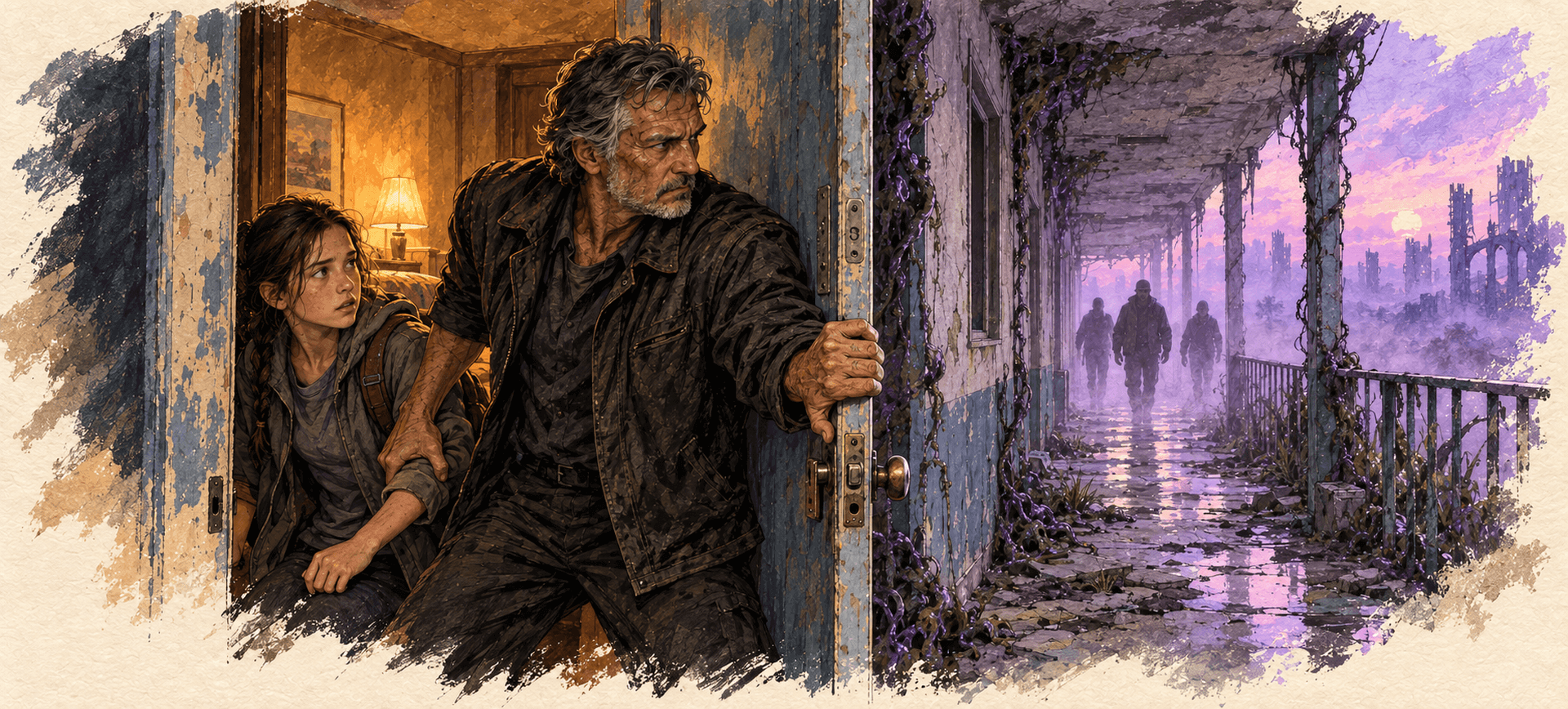
You never forget the first time you see a bully get punched in the face. It’s a glorious bit of comeuppance, usually long overdue. But all too often, the punch never comes. At least not in the real world.
Which is why we need stories where a bad guy meets someone who refuses to bend the knee, and makes him wish he’d picked an easier victim.
That someone doesn’t always need to be good.
That someone doesn’t always need to be good.
The reluctant protector is one of my favorite tropes to write: a world-weary antihero who’s tired of fighting but happens to be very, VERY good at it. They’ve seen too much, lost too much, and survived too long in places where might makes right. Staying alive has already cost them pieces of their moral code. Then someone vulnerable gives them a reason to find those pieces again.
Take Léon from 1994’s The Professional. He’s a hit man who never got to have a childhood. The man who took him in turned him into an assassin, kept him uneducated, and made sure he remained dependent. Léon lives a simple life by design: no relationships and no possessions beyond the plant he meticulously cares for. His only real joy is watching classic movies with the childlike wonder he never got to outgrow.
Mathilda, a 12-year-old girl down the hall, has had a tough life. She’s street smart because she’s had to survive shitty parents and an older sister who torments her. The only shining light in her life is her little brother. So when she comes home one day to find DEA officers standing in the hallway outside her apartment, she knows something is wrong. Her self-preservation kicks in. She keeps walking.
As she passes her open door, Mathilda sees her little brother’s body. Somehow she keeps walking to the end of the hall, tears in her eyes, and knocks on Léon’s door. He shouldn’t get involved. He’s a hit man, and the last thing he needs is trouble with corrupt DEA agents. But the man behind Mathilda has noticed her. He’s about to connect the dots, and when he does, she’s dead.
Léon has two choices: open the door or leave the girl to die.
Even though Léon is a hitman who takes kill orders on request, he has a strict moral code. “No women, no children.”
He does the only thing he can do. He opens the door. Lets Mathilda in.
And thus begins one of the best action movies of the ’90s, even with the creepy undertones that sailed right past me when I was younger. Léon steps into action to protect Mathilda from the dirty Feds who murdered her family, and he’ll kill anyone he has to keep her safe.
Léon is a great example of the reluctant protector. But he’s only one character in a lineage stretching from the disgraced warriors of ancient folklore through Westerns, modern vigilante stories, and imagined futures.
Then there’s Hugh Jackman in 2017’s Logan, which carries the trope into an alternate X-Men future. Logan used to be Wolverine, a bad-ass, virtually indestructible mutant with big ass retractable claws. He was tough, quick witted, didn’t care if he pissed you off, and wouldn’t think twice about putting his claws through your chest if you messed with him.
But adamantium poisoning has left him weakened in a world where no mutants have been born in 25 years. Mutants are hated, feared, and hunted by paramilitary cyborgs called Reavers. Logan hides in plain sight as a weary limo driver while secretly caring for Professor X, his old mentor and one of the world’s most powerful telepaths, now suffering from dementia.
Logan gets a job: escort a young girl named Laura to Eden, a place that may or may not exist near the U.S.-Canada border.
One other thing: Laura is a mutant. Not just a mutant, but a mutant with claws and an adamantium skeleton and fast healing, just like him.
She’s also his daughter. Long story. And she’s just as fiery and terrifyingly brutal as he was in his early days. What follows is arguably the best comic book movie ever made.
Another recent example is Joel from The Last of Us. The video game and HBO series take place after a fungal apocalypse that Joel survived by learning not to get too attached to anyone. Then he’s forced to smuggle Ellie, the only known person to have been bitten and survived. Her immunity might hold the answer to the infection, but getting her to safety means crossing a broken country filled with infected monsters and humans every bit as deadly.
Joel and Ellie gradually become a classic father-daughter pairing, complete with all the usual friction, except their road trips involve fewer arguments over music and considerably more zombies.
And with that tension comes Ellie’s idealism versus Joel’s practicality. Joel won’t think twice of killing someone if there’s even a chance that mercy could cost him. Ellie is still clinging to a childhood she didn’t get to have. That’s what makes Joel such a powerful version of the trope. By the end, his love for Ellie and his willingness to do terrible things are impossible to separate. He saves her, but may have doomed everyone else to do it. It’s selfish and monstrous, and I still understand exactly why he makes the choice.
As someone who grew up bullied and escaped into comic books and horror stories, I’ve always loved watching fictional bullies get the ending real life rarely gave them. I’m especially drawn to the gruff badass who stands up for someone unable to fight back. Better still when he isn’t a hero, but someone badly in need of redemption, even if he lives in violent denial of that need.
So when my writing partner Sean Platt and I decided to revisit our best-selling post-apocalyptic series Yesterday’s Gone, we knew it would center on our most popular character, Boricio Wolfe.
Boricio was born into violence and grew up to become a serial killer. During the original trilogy, a boy carrying an alien parasite “fixes” him, inoculating Boricio against some of the poison that made his violence so wanton and indiscriminate.
I wanted to know what became of Boricio after Yesterday’s Gone. The dueling parasites inside him have forced him into exile because he’s become a danger to everyone he loves. He spends his later years trapped on another version of Earth, one mostly swallowed by an alien presence that has choked the planet beneath a purple haze. He’s immune, so by day he takes jobs inside the infected zones. At night, he gets drunk enough to forget how alone he is.
Soon he’s protecting a girl hunted by a sinister underground group, even though the last thing Boricio wants or needs is an annoying kid depending on him. We wrote with Logan, Man on Fire, The Professional, and True Grit rattling around in our heads: a once-terrible man becoming the only man this ruined world can depend on.
The person who needs help can knock on the door and find nobody willing to open it.
Real life doesn’t always give us the bully-punched-in-the-face ending. Bad people get away with things. Good people get hurt. The person who needs help can knock on the door and find nobody willing to open it.
Stories let us open the door.
Maybe that hope is a lie. I think it’s a salve. A reminder that broken people can still choose to protect someone, and sometimes the person you should fear most is the only one willing to stand between you and something worse.
David Wright is an author and cartoonist. He co-created the Yesterday’s Gone universe with Sean Platt. Tomorrow’s Gone is a standalone trilogy in that universe.